Showing posts with label fake news on social platforms. Show all posts

Thursday, February 21, 2019

How to Spot and Report Fake News on Social Media

I've written a number of times about fake news including this post on how to recognize fake news on social media. It's an important subject because there's so much of it.

The first rule is to be sure information comes from a trustworthy site. Well-known sites are one thing, but there are many sites today reporting interesting news that individuals may not be personally familiar with. I use a browser extension called NewsGuard. It maintains a list of trusted sites and shows a green check by search results for those sites. Users can submit other sites for consideration. The important caveat is that it evaluates the site, not the individual news item. It is helpful, but certainly not a complete answer. Users still have to be on the alert.

https://www.factcheck.org/2016/12/video-spotting-fake-news/
So here are some resources. FactCheck.org is run by the Annenberg Public Policy Center; the site owner is one of the keys to trustworthiness. It has a video as shown in the graphic. The site's post on the subject is a couple of years old, but all its points are still valid. FactCheck.org is one of the fact checkers working with Facebook to identify false news. I wish them luck, but without a lot of optimism.

It would certainly help if users themselves pointed out suspect content. Here are three sites you might want to consider using:

Facebook:  Users can check the validity of a post before they share it. How often that is helpful depends on the success of Facebook's own attempts to identify fake content. Users can ask Facebook to investigate content. Facebook says users can check the status of their request.

Google: The help page says the user can see fact checks in search results. It also says that the fact checks are conducted by publishers and it sounds as if that means a site fact-checking its own content. That doesn't seem to be the meaning. The fact-checked search results I can find have been checked by one of the established fact checking sites. That means the fact checks are credible but it also means that only s small set of politically-oriented content is included. Try some searches for statements that are frequently presented as fact and see what you find.

The Poynter Institute points out that Google is building a search engine for fact checks. It is still in beta and I doubt if anyone except a journalist is going to get access at present. If it works and is opened to the public it would be a step forward.

YouTube: The site has been adding encyclopedia links to videos that seem to promote conspiracy theories. Slate has an article that explains pros and cons and shows an example. I can't find anything recent on how that's going or whether it plans to add other topics.

That's a short and not very inspiring look at the current status of fact-checking, especially on social media sites. Much remains to be done before users should share with any degree of confidence unless they have other sources to validate social media posts.

If you have any experience using any of these tools and sites, your comments would be welcome.

Stay Safe!

Thursday, October 25, 2018

Tools For Identifying Fake News

It's important to remember that the internet/social media did not invent fake news. It's been around forever. However, it is equally true that the internet distributes fake news at an incredible speed and social media is the main, but not the only, culprit. Hence, yesterday's post about how to identify fake news in social media.

If you found that a bit disappointing--the advice is not terribly different from that for identifying fake news in any context--you are exactly right. It's reasonable to ask whether there are any tools that could be helpful.

Before a brief listing of tools, a word about fake news itself. Most of us have read ad nauseum about foreign interference. A lot of it is alarmist and lacking in factual data. I've found two thoughtful reports if you want to review them to be sure what you're looking for. A recent report that is detailed and factual comes from Ars Technica. I took the graphic from there; it was the least repugnant one in that set; you are welcome to look further. The other is a brief post from Axios about uses of social media by various governments.


Now on to tools The best known is one called Botcheck.me. Just a visit there is interesting because it shows the trending hashtags and most active Twitter accounts for the past 24 hours. It's easy to put your Twitter account name in and find out if you have suspicious patterns suggesting the presence of fake news sites. Mine didn't show any, which is not surprising, because I follow mostly business news sites. There are a few more but most, like Botcheck.me which only works on Twitter, are somewhat specialized.

Facebook also has a tool that let you see whether you've followed or liked any suspicious pages. 

The most used tools are probably the fact-checking sites.These have been around for awhile. I've used them all and find them to be reliable:

They all have interesting posts about the stories they research. It's worth following one or two of them just to keep up with what's out there.

Tomorrow is the last #CyberAware day. The month has flown by!

Stay Safe!
Updated 10/25, 11:45 am

Wednesday, October 24, 2018

How to Identify Fake News in Social Media

Identifying fake news on social media platforms is difficult for the individual user, primarily because it comes from trusted friends. It is also particularly dangerous for the same reason; the trusted source makes it more likely to be believable.


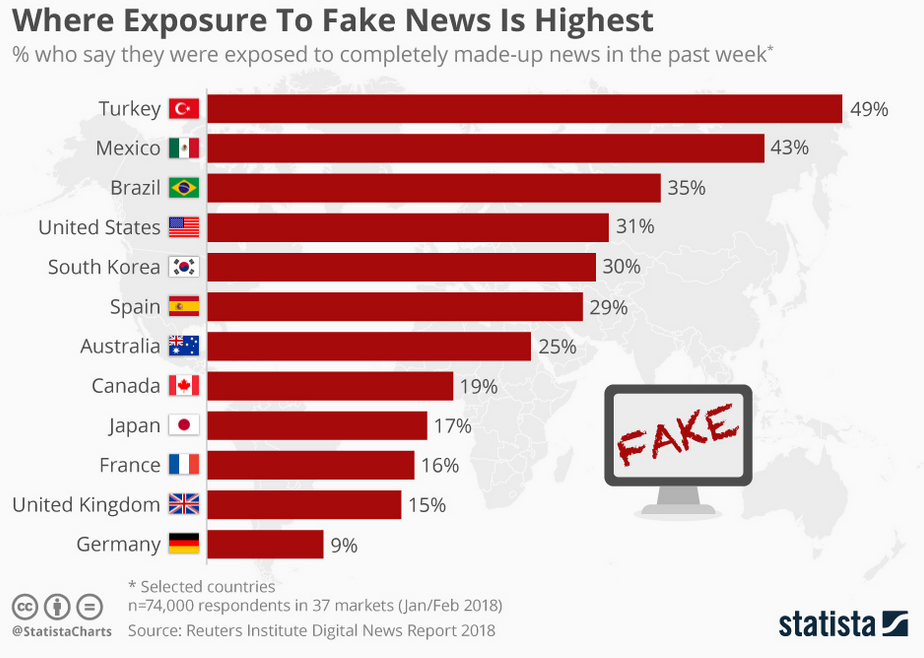
Analytics site Statista has an interesting page that highlights numerous pieces of data about fake news. The data in this first chart should surprise no one. As a single site Facebook is still king of the hill when it comes to fake news, although Twitter is not that far behind.


If you too feel surrounded by fake news, the second chart will be interesting. It shows the U.S. to be considerably behind three other countries in terms of exposure to fake news. There may be reasons why various countries have different levels of exposure to fake news, but they are not evident upon simple inspection.


NBC news explains a bit how bots work to distribute fake news and gives some tips for recognizing a fake news post when you see it. The advice may seem a bit familiar, but it is good. Remember that the source of fake news is something fake. Their recommendations have some good commentary:
  • "Question the source. If a story comes from a newspaper, is it from a reputable site? The Denver Guardian, cited often in 2016, never existed and listed an empty car park as its address.
  • Look for confirmation. If you don’t see a story across mainstream media, there’s probably a good reason why. “Mainstream media is motivated by getting an audience.” Huxley* says.
  • Check the facts with third-party sites like Snopes and Politifact. Admittedly, though, fact checking has its limits. By the time a claim is researched and proven false, it may have already reached millions of accounts.
  • Call out fake news you see in your network — but do it privately. “What polarizes people further is calling them out publicly. Then people get defensive because it makes them look stupid or gullible for posting it in the first place.” Huxley says." 
*Sam Huxley. practice chair of risk and business strategy, for the communications firm LEVICK.

 
Those are good suggestions, and we should all be following them. The article has another good idea, though, "Burst your own bubble." We all live in self-created bubbles these days. In following content we enjoy we have surrounded ourselves with content we agree with. Subscribe to some feeds that provide alternative points of view. Your own perspectives will be stronger after some reflection.

There are other sites and a few tools that can help in this challenging endeavor. I'll discuss some of those tomorrow.

Stay safe!

Why I'm Writing A Blog About Personal Data Protection

The subhead states the mission of the blog. I want to make key methods for protecting user data privacy and identify comprehensible to the m...