Showing posts with label identifying fake news. Show all posts

Thursday, October 25, 2018

Tools For Identifying Fake News

It's important to remember that the internet/social media did not invent fake news. It's been around forever. However, it is equally true that the internet distributes fake news at an incredible speed and social media is the main, but not the only, culprit. Hence, yesterday's post about how to identify fake news in social media.

If you found that a bit disappointing--the advice is not terribly different from that for identifying fake news in any context--you are exactly right. It's reasonable to ask whether there are any tools that could be helpful.

Before a brief listing of tools, a word about fake news itself. Most of us have read ad nauseum about foreign interference. A lot of it is alarmist and lacking in factual data. I've found two thoughtful reports if you want to review them to be sure what you're looking for. A recent report that is detailed and factual comes from Ars Technica. I took the graphic from there; it was the least repugnant one in that set; you are welcome to look further. The other is a brief post from Axios about uses of social media by various governments.


Now on to tools The best known is one called Botcheck.me. Just a visit there is interesting because it shows the trending hashtags and most active Twitter accounts for the past 24 hours. It's easy to put your Twitter account name in and find out if you have suspicious patterns suggesting the presence of fake news sites. Mine didn't show any, which is not surprising, because I follow mostly business news sites. There are a few more but most, like Botcheck.me which only works on Twitter, are somewhat specialized.

Facebook also has a tool that let you see whether you've followed or liked any suspicious pages. 

The most used tools are probably the fact-checking sites.These have been around for awhile. I've used them all and find them to be reliable:

They all have interesting posts about the stories they research. It's worth following one or two of them just to keep up with what's out there.

Tomorrow is the last #CyberAware day. The month has flown by!

Stay Safe!
Updated 10/25, 11:45 am

Wednesday, October 24, 2018

How to Identify Fake News in Social Media

Identifying fake news on social media platforms is difficult for the individual user, primarily because it comes from trusted friends. It is also particularly dangerous for the same reason; the trusted source makes it more likely to be believable.


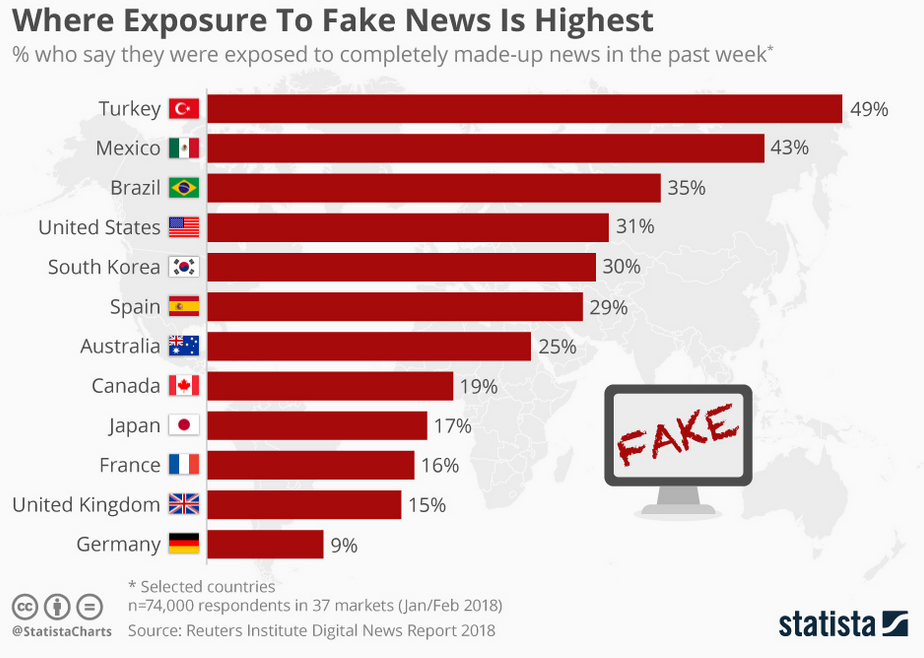
Analytics site Statista has an interesting page that highlights numerous pieces of data about fake news. The data in this first chart should surprise no one. As a single site Facebook is still king of the hill when it comes to fake news, although Twitter is not that far behind.


If you too feel surrounded by fake news, the second chart will be interesting. It shows the U.S. to be considerably behind three other countries in terms of exposure to fake news. There may be reasons why various countries have different levels of exposure to fake news, but they are not evident upon simple inspection.


NBC news explains a bit how bots work to distribute fake news and gives some tips for recognizing a fake news post when you see it. The advice may seem a bit familiar, but it is good. Remember that the source of fake news is something fake. Their recommendations have some good commentary:
  • "Question the source. If a story comes from a newspaper, is it from a reputable site? The Denver Guardian, cited often in 2016, never existed and listed an empty car park as its address.
  • Look for confirmation. If you don’t see a story across mainstream media, there’s probably a good reason why. “Mainstream media is motivated by getting an audience.” Huxley* says.
  • Check the facts with third-party sites like Snopes and Politifact. Admittedly, though, fact checking has its limits. By the time a claim is researched and proven false, it may have already reached millions of accounts.
  • Call out fake news you see in your network — but do it privately. “What polarizes people further is calling them out publicly. Then people get defensive because it makes them look stupid or gullible for posting it in the first place.” Huxley says." 
*Sam Huxley. practice chair of risk and business strategy, for the communications firm LEVICK.

 
Those are good suggestions, and we should all be following them. The article has another good idea, though, "Burst your own bubble." We all live in self-created bubbles these days. In following content we enjoy we have surrounded ourselves with content we agree with. Subscribe to some feeds that provide alternative points of view. Your own perspectives will be stronger after some reflection.

There are other sites and a few tools that can help in this challenging endeavor. I'll discuss some of those tomorrow.

Stay safe!

Tuesday, October 23, 2018

How Can You Tell It's Fake News?

Fake news is not new. Apparently the Ancient Greeks were masters of it. However, the Ancient Greeks didn't have the internet. We all know that fake news flourishes there. Problem is, how do we spot it.

Here's an infographic from the IFLA with 8 good tips. And the infographic itself provides several good lessons.

https://www.ifla.org/publications/node/11174

Lesson 1. It's from the International Federation of Library Institutions and Associations. That's a mouthful, so the acronym is much appreciated. But it's easy to look up (search for) with almost 3 million results. The first ten, at least, look entirely reputable.

Lesson 2. The infographic has the name of the organization as part of the graphic. That's not a solid clue because some fake news organizations like to promote their names and make it easy to find their content also. However, checking on the origin of the publication is important if you have any doubt at all, and making it easy is good.

Lesson 3. I've put the URL for the link in the caption anyway. It's a .org, not some kind of flaky URL. That's super important. That's the key issue, but the name of the organization in the link is also correct and straightforward. No deception here.

Lesson 4.  The website itself is solid, not a thrown-together mishmash. It has a really interesting set of pages on their vision for the future of libraries. More relevant to the current issue, the article has a link to FactCheck.org, which is a well-known fact-checking group.

Lesson 5.  Finally, I'll give the advice I've been giving my students for years. Use the golden rule of journalism. Two sources are necessary. Three is the gold standard. If three reputable publishers agree on the facts, there's a good chance they are true.

If there are opposing arguments, keep on reading. That's one thing we do too little of these days--listening to arguments from opposing sides. 

Hint: it gets more difficult from here on in. Tomorrow I'm going to tackle how to identify fake news on social media feeds.

Stay Safe!

Related Updates
Good example of fake news targeting the Red Cross
How fake news happens 

Why I'm Writing A Blog About Personal Data Protection

The subhead states the mission of the blog. I want to make key methods for protecting user data privacy and identify comprehensible to the m...